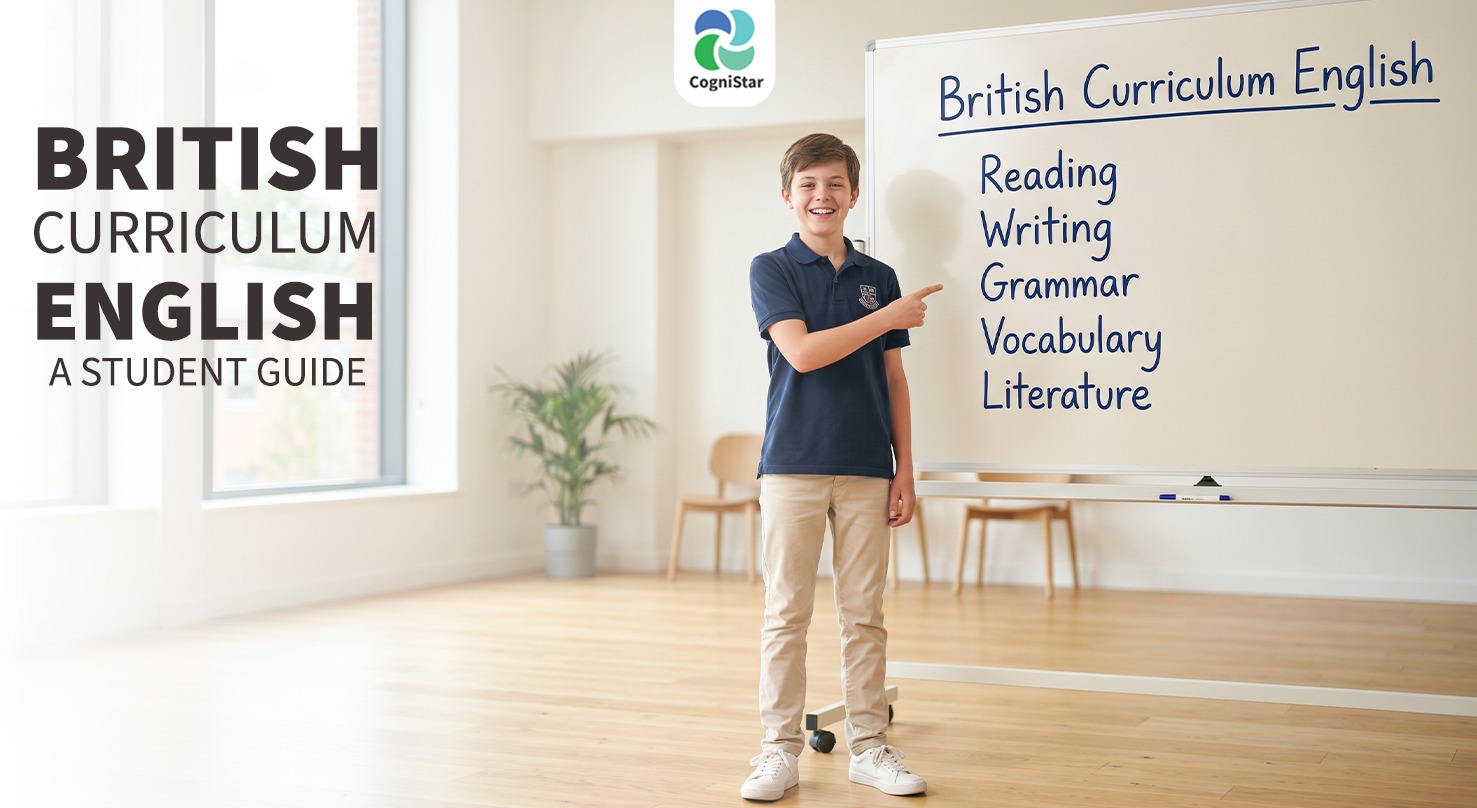
The British curriculum — and
particularly the IGCSE English programme — is one of the most respected and
widely taught educational frameworks in the world. Offered by Cambridge
Assessment International Education, it is followed by hundreds of schools
across the Middle East, Asia, Africa, and Europe. For students in Grades 5 through
10, understanding what the British curriculum English programme involves, and
what it demands, is the first step to succeeding within it.
British curriculum English places
a strong emphasis on communication skills in their broadest sense. Unlike some
national curricula that focus primarily on literature or grammar in isolation,
IGCSE English Language develops the ability to read with comprehension, write
with purpose and accuracy, and communicate ideas effectively in a variety of
contexts. These are lifelong skills with relevance far beyond the examination
room.
The curriculum is structured
progressively. Students in the lower years — Grades 5 through 7 — focus on
foundational skills: basic grammar, simple text comprehension, and short
writing tasks. As they move into Grades 8 through 10, the complexity increases significantly.
Texts become more sophisticated, writing tasks demand more developed arguments
and stylistic choices, and assessment standards become more rigorous.
Reading under the British
curriculum requires students to engage critically with a wide range of text
types: fiction, autobiography, travel writing, journalism, speeches, and
persuasive articles. Students must be able to identify the writer's purpose,
analyse language choices, evaluate the effectiveness of techniques, and compare
multiple texts. This critical reading ability is not developed overnight — it
requires years of guided practice.
Writing in the British curriculum
is assessed on two main dimensions: the quality of communication (ideas,
structure, coherence, and appropriateness to purpose and audience) and the
quality of language (grammar, vocabulary, punctuation, and spelling). Students
must demonstrate competence in both dimensions to achieve high grades.
Grammar instruction in the British
curriculum is functional rather than purely academic. Students learn grammar
rules in order to apply them in their own writing, not simply to label parts of
speech on a worksheet. This applied approach means that grammar knowledge
directly improves writing quality — which is the ultimate goal.
Assessment in IGCSE English is
primarily through written examinations, as described in earlier guides.
However, some Cambridge syllabuses also include a spoken language endorsement,
which assesses a student's ability to communicate clearly and effectively in
presentations or discussions. This spoken component reinforces the curriculum's
holistic approach to language development.
CogniStar's programme is
specifically designed for students following the British curriculum. Our
instructors are experts in Cambridge IGCSE English, ensuring that every lesson
is aligned with examination requirements, delivers the skills students need,
and prepares them comprehensively for their final assessments.
For international families choosing a school system or
supplementary tuition, the British curriculum offers a rigorous, globally
recognised education that develops genuine intellectual and communicative
ability. With expert support from CogniStar, students across Grades 5 to 10 can
navigate this curriculum with confidence and success
British
curriculum English, IGCSE British curriculum, international school English,
Cambridge curriculum English, British English for students
Comments (0)

Courses
Recent posts

Brief Overview of the Importance of ...
2 Sep 2025
Igcse Subjects Explained
25 Nov 2025
Why Choose IGCSE Exam Preparation ...
2 Sep 2025


